Why Highway Autonomy Stacks Fail on Footpaths
Full-size autonomous cars can draw 800 watts of liquid-cooled compute power and carry roof racks costing thousands of pounds. A personal mobility chair or grocery courier operates on a 1,000-watt-hour battery pack; if its computer consumes 400 watts, half its travel range vanishes before a wheel turns.
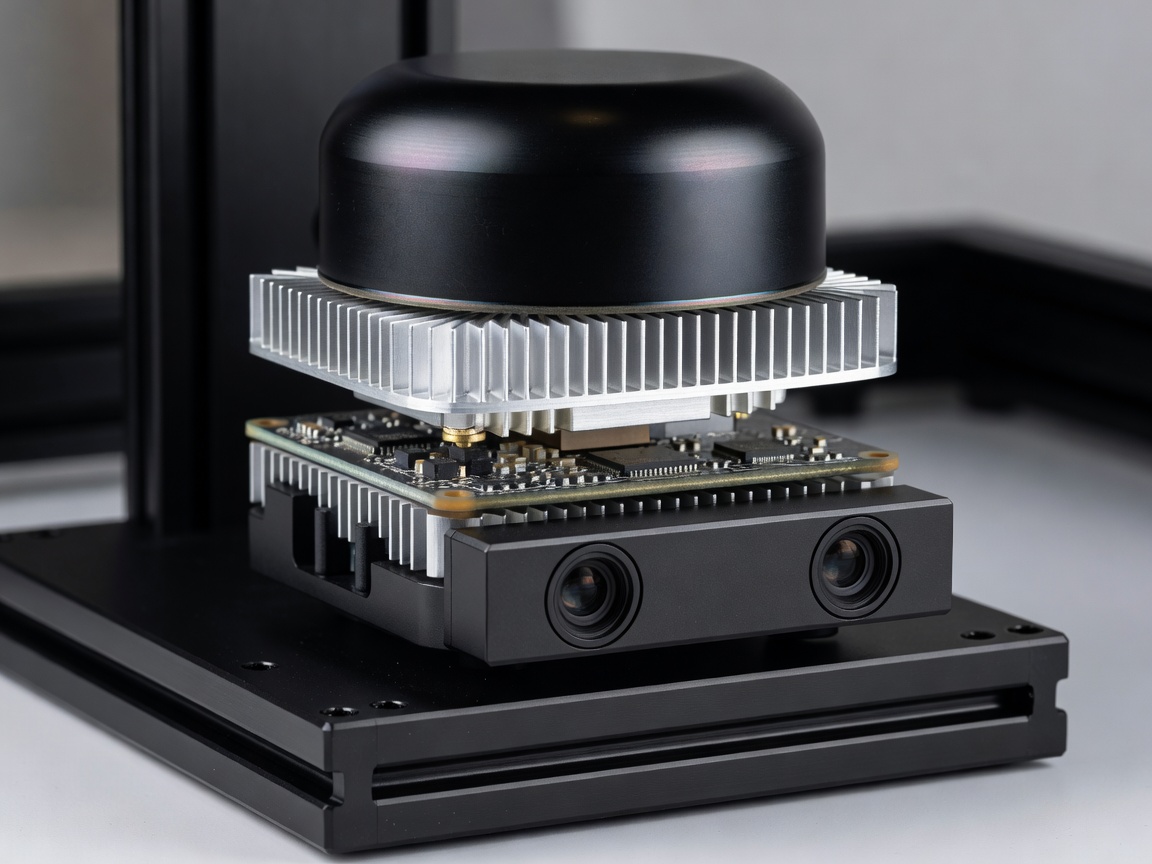
Compact machines instead deploy embedded system-on-modules like NVIDIA Jetson Orin NX or Qualcomm Robotics RB5, running quantized neural networks at 20 to 45 watts. Furthermore, cameras sit only 45 cm above the ground—looking upward at pedestrian knees, puddles reflecting neon signage, and overhanging hedges that look solid to lidar yet brush harmlessly aside, versus thin steel bollards that must never be struck.
Closed-Loop Micro-Mobility Autonomy Pipeline (100 ms Cycle)
Sensor Modalities: What Each Eye Actually Sees
Debates pitting "camera-only" vision against lidar miss the engineering reality of short-range personal transport: failure modes must be orthogonal. When low winter sun glares directly into CMOS image sensors at sunset, active 905 nm time-of-flight lidar and 60–77 GHz millimetre-wave radar continue measuring exact metric depth.
- Stereo & Monocular Occupancy Vision: Excels at semantic nuance—distinguishing a red pedestrian crossing signal from a tail-light, reading temporary roadwork signs, and spotting wet ice sheen.
- Compact 3D Lidar: Non-repetitive scanning and solid-state VCSEL arrays deliver millimetre-precise curb-edge geometry in pitch darkness without illuminating pedestrians with visible headlights.
- Millimetre-Wave Radar: Penetrates fog, steam rising from subway grates, and mud splatter on optical domes while providing instantaneous radial velocity via Doppler shift.
- Ultrasonic & Tactile Bumpers: Provide last-centimetre certainty against transparent plate-glass storefronts where both cameras and infrared laser pulses can pass straight through.
Solving "The Freezing Robot Problem"
Early academic robots modeled every walking human as an unpredictable expanding circle of risk. Placed in a busy railway concourse, the planner concluded every trajectory carried non-zero collision probability and halted indefinitely—a phenomenon roboticists call the Freezing Robot Problem.
Modern ROS 2 Nav2 extensions and learned cooperative planners treat navigation as joint negotiation. By subtly angling 15 degrees toward the curb fifteen metres early and modulating speed smoothly, the cart communicates legible intent to oncoming walkers and dogs without needing verbal loudspeakers. When ambiguity exceeds confidence thresholds—such as a police officer hand-waving traffic around a burst water main—the stack pauses safely at the pavement edge and requests a five-second waypoint confirmation from a remote fleet dispatcher.