Two Divergent Architectures: Pavement vs. Carriageway
Autonomous local freight has bifurcated into two distinct mechanical classes governed by kinetic energy limits. Personal Delivery Devices (PDDs)—exemplified by Starship Technologies, Serve Robotics, Kiwibot, and Cartken—stay on pedestrian footpaths at 5 to 7 km/h with gross weights under 55 kg. At walking pace, emergency stopping distances measure under forty centimetres.
Conversely, road-going sub-compact pods such as Nuro's R3 and China's Neolix X3 occupy bicycle lanes or 40 km/h urban streets. Moving into traffic multiplies payload capacity from three grocery bags to 190 kg, but demands automotive-grade airbags or external pedestrian-protection crumple zones, redundant hydraulic braking, and multi-sensor 360-degree long-range lidar.
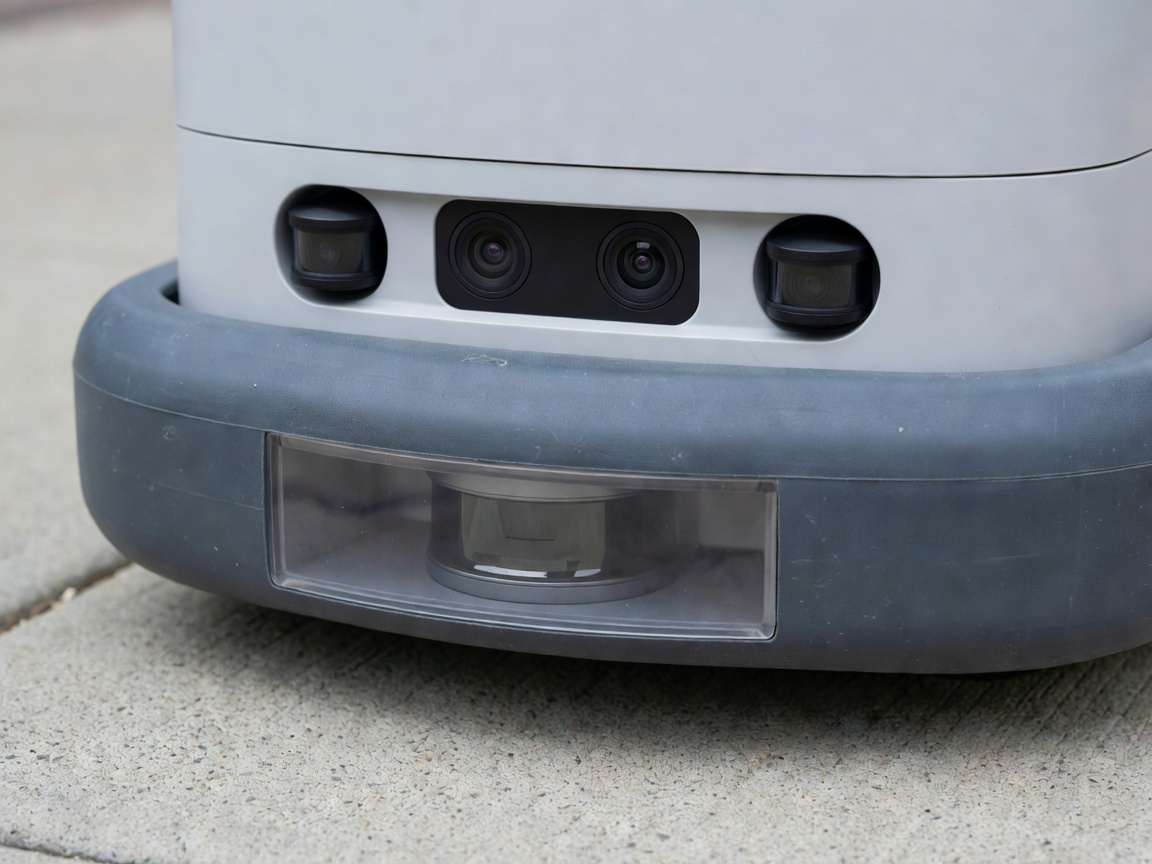
| Platform Example | Operating Zone | Max Payload | Top Speed | Suspension / Drive Layout | Status (2026) |
|---|---|---|---|---|---|
| Starship Gen 3 | Sidewalk / Campus | 10 kg | 6 km/h | 6-wheel articulated rocker-bogie | Commercial Fleet |
| Serve Robotics Gen 3 | Urban Sidewalk | 23 kg | 11 km/h | 4-wheel skid/differential + active lidar | Commercial Fleet |
| Clevon CLEVON 1 | Low-speed Urban Road | 150 kg | 45 km/h | 4-wheel automotive chassis, modular lockers | Regional Pilots |
| Stair-Climbing Biped/Wheel Hybrids | Apartment Steps | 15 kg | 5 km/h | Wheeled-legged active knee actuators (e.g., Ascento / Swiss-Mile) | Industrial Demo |
Chassis Mechanics: Surviving 10,000 Curb Drops
Sidewalks look benign to human walkers, yet to a 200 mm wheel a 50 mm frost-heaved flagstone represents a quarter-wheel-diameter vertical wall. Early four-wheeled rigid carts suffered cracked solder joints and scrambled inertial sensors within months of deployment. Starship borrowed planetary rover geometry—specifically a passive six-wheel rocker-bogie linkage—allowing the front wheel pair to lever upward over kerbs up to 18 cm while middle and rear wheels maintain tractive contact.
Battery chemistry also shifted quietly from high-cobalt NMC cells toward lithium iron phosphate (LiFePO4). Because sidewalk bots travel slowly and carry insulated thermal cargo tubs, an extra three kilograms of battery mass scarcely affects range, whereas LiFePO4 delivers over 3,000 charge cycles and superior thermal runaway resistance during inductive apron charging outdoors in Milton Keynes winters or Phoenix summers.
"Removing the human courier drops per-delivery cost near zero."
Pitch decks compare a £0.04 electricity charge directly against a gig-worker fee.
Teleoperation, field rescue, and merchant loading dominate unit cost.
Profitability hinges on the human-to-robot supervision ratio (moving from 1:3 toward 1:25+), vandalism recovery vans, cellular multi-SIM data bonding, and restaurant staff walking outdoors to load locked hatches.
Curb Governance and Accessibility Friction
Public footpaths are scarce civic infrastructure. Disability advocacy groups and municipal transport departments in cities from Toronto to Pittsburgh have scrutinized how stationary or queuing bots interact with wheelchair users and visually impaired pedestrians using white canes. Consequently, standard ISO 4448 (Intelligent Transport Systems — Public-area mobile robots) establishes formal protocols for sidewalk etiquette, audible acoustic beacons, curb-ramp queueing priority, and bilateral municipal APIs that prevent ten rival carts from clustering outside one popular noodle shop.
Indoor Robotic Transport: Hospitals and Hotels
Away from rain and curb cuts, indoor autonomous mobile robots (AMRs) such as Relay Robotics, Aethon TUG, and Keenon carts represent the quietest success story in personal-scale transport. By integrating over Wi-Fi or local ultra-wideband relays directly with Otis and Schindler elevator controllers, hospital pharmacy bots move blood samples and linens 24 hours a day with zero GNSS dependency and predictable vinyl flooring.